
Lack of Financial Support is a Major Obstacle to Increasing International Success
Phnom Penh, 24 June 2026
Fencing has been prominent in Cambodia since the 1960s, but due to the civil war in the 1970s, the sport had to be re-established in 2006. Over these past 20 years, the Fencing Federation of Cambodia has trained a significant community:
Coaches: Approximately 12 national and international certified coaches
Referees: 10 national referees and 1 international referee
Officials: 13 competition organizers
Athletes: Around 230 male and female athletes (aged 8 and above)
The federation has also guided fencers to compete from the regional level up to the world stage, bringing back a total of around 60 medals for the nation. Cambodia's very first medal was a bronze in the men's team epee event at the 2013 Southeast Asian Junior and Cadet Fencing Championships in Brunei. However, in recent years, the federation seems to be taking a step backward and moving more slowly than before, as expenses have increased while participation from the private sector has almost completely dropped off.
Following the 2023 Southeast Asian Games, Cambodian fencing fencers have had very little presence on the international stage, making the world almost forget that Cambodia is a member of the fencing family. For instance, for their participation in the 2026 Asian Senior Fencing Championships—taking place from June 19 to 24, 2026, in New Delhi, India—our fencers joined with half of the total expenses coming directly out of their own pockets.
Several athletes shared the financial burdens they face to compete:
"Without financial assistance from the International Fencing Federation, sponsorship from the President and the Vice President, Mr. Kchao Sopheap, and flight ticket sponsorship from the Air Cambodia, I probably would not have been able to participate because I just broke two swords during the recent National University and Technical Secondary School Games in early June. Just those two foil blade’s cost about $400, plus the $100 competition entry fee, travel, accommodation, and food; for me alone, it costs about $1,000." Hai Sreysros expresses her feelings.
Tima also gave his words that,"I rely on my national team salary and borrowed some money from my relatives to participate, but I still lack some swords and equipment that I need to buy."
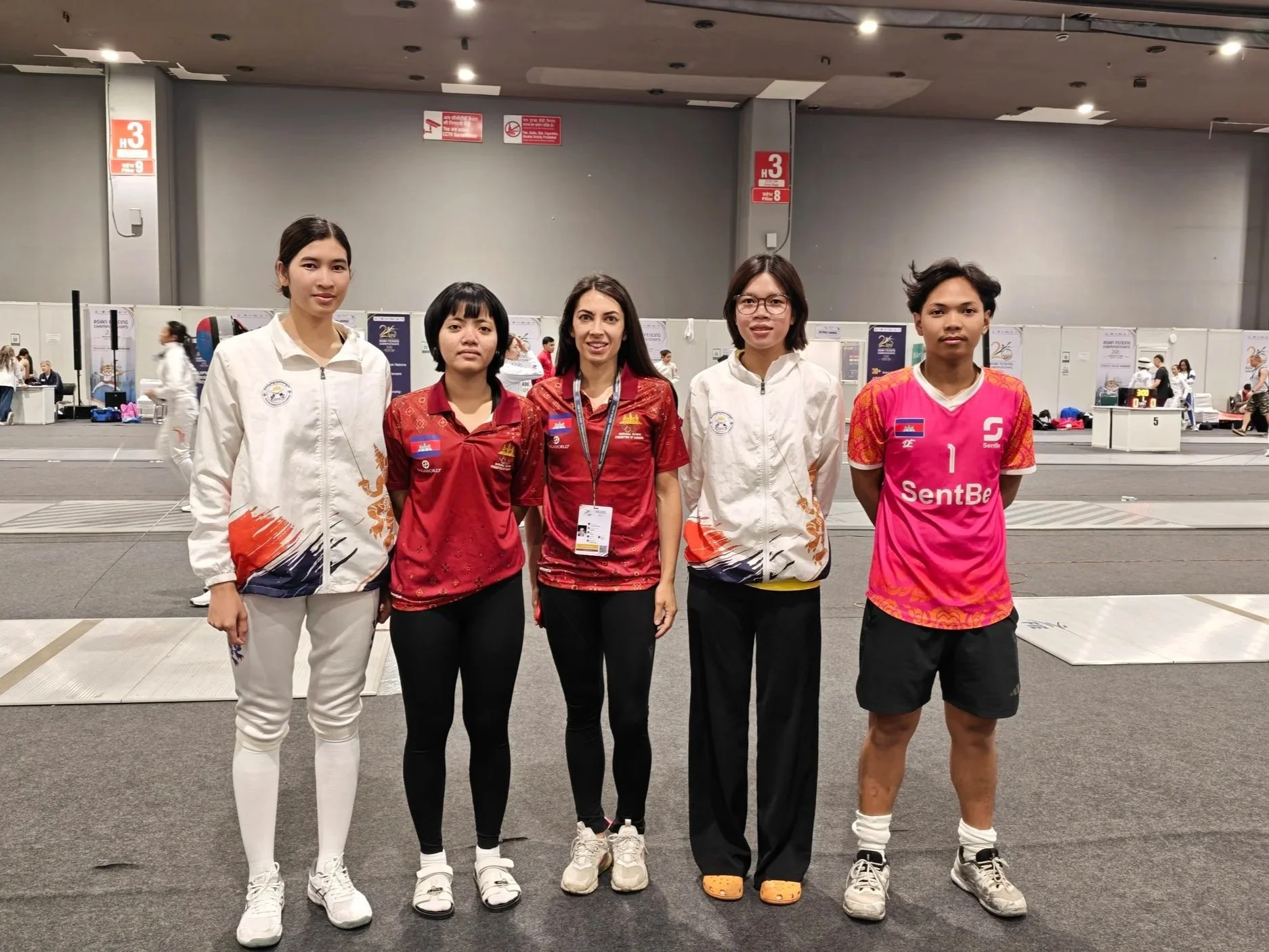
"Preparing food and medicine is also a crucial point because food in some countries is hard to eat and expensive. And when we are sick or injured, we do not have a doctor, a massage therapist, or medicine to use. So, we pool our money together to buy medicine and some dried food to eat and to protect ourselves in case an accident occurs."Men Monika added.
As for the Cambodian-Italian female athlete, all competition expenses are entirely her own burden.
Mr. Thong Tangchin, the Treasurer General of the federation, stated that each year there are major regular competitions essential for gaining experience, winning medals for the nation, accumulating points to maintain annual rankings, and qualifying for the Olympic Games. To participate in all these competitions requires at least $60,000 to $100,000 per year, depending on the host countries and the number of participants. This does not even include the cost of training and competition equipment for the fencers.

However, in this specific competition, the team received flight ticket sponsorship from the Air Cambodia, as well as cash from the President Te Lurarent, Vice President Mr. Hu Jianhai, and Federation Executive Member Mr. Kchao Sopheap. The team hopes that other executive members and the private sector will step in to sponsor and help boost the sport of fencing so it can become more vibrant and prosperous.
